
The line
that never blinks.
Autonomous visual inspection at production speed. Lynx sees microscopic scratches, casting flaws, paint runs and weld defects on every unit that passes — continuously, identically, without fatigue.
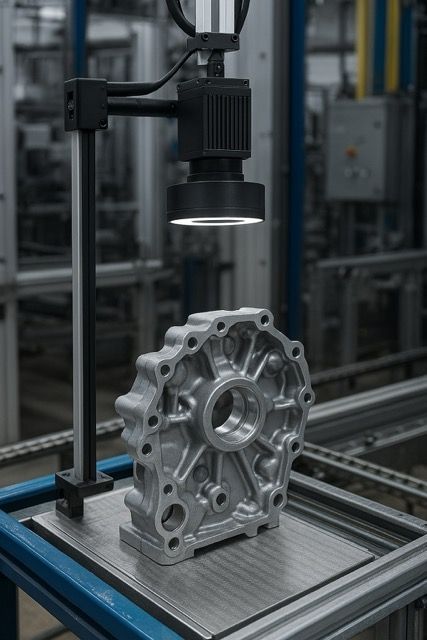
Capture
Fixed cameras and controlled lighting image each unit at line speed, from the angles that matter.
Detect
Models trained on your parts segment defects at pixel level and separate them from cosmetic noise.
Decide
Each unit is classified against your acceptance thresholds — pass, rework, reject — with a reason.
Act
The verdict goes straight to the PLC or MES: reject gates, rework routing, live process alerts.
One camera, one verdict, every part — before it leaves the cell.
Nothing waits for a lab, a sampling window or a shift review. The unit is imaged, graded against your acceptance criteria and routed — while it is still moving.
Graded, not just flagged
Every finding carries a class, a size and a confidence — so a 0.2 mm cosmetic mark and a structural flaw don't share a verdict.
Reasoned rejects
The operator sees why a unit failed, with the pixels highlighted. No black-box stops on the line.
Traceable per serial
The image, the verdict and the model version are stored against the unit for warranty and recall questions later.
The defects you catch are worth less than the ones you prevent.
Because Lynx sees every unit, it sees the trend before the scrap does. A tool wearing, a bath drifting, a supplier batch shifting — these appear as a slow change in defect distribution hours or days before anything crosses a threshold.
Process signals, not just QC
Defect type, position and severity are trended per station, shift, tool and supplier lot.
Early warning
Alerts fire on drift in the distribution, not on a single bad unit — the way an experienced line lead would read it.
Root cause with evidence
Every alert links back to the actual images behind it, so the argument on the shop floor is short.
Sampling tells you what probably happened. Lynx tells you what did.
100% inspection coverage
Every unit, every shift. No sampling plans, no statistical hope, no missed batches.
Pixel-level accuracy
Defects far below reliable human detection, graded by severity rather than a binary pass/fail.
Consistent by construction
The same part gets the same verdict at 3am on a Sunday as at the start of a Monday shift.
Drift detection
Defect patterns are trended over time so you see a tool wearing or a bath drifting before scrap appears.
Plugs into your line
PLC, MES and SCADA integration for real-time reject routing and full traceability per serial.
Retrains on your data
New part, new finish, new defect class — the model is extended without rebuilding the cell.
- Hardware
- Industrial area or line-scan cameras with controlled lighting, specified per part and cycle time.
- Compute
- Edge inference at the cell; no dependency on plant network or cloud availability.
- Line integration
- PLC over OPC UA or digital I/O; MES and SCADA for traceability and reporting.
- Training data
- Starts from a few hundred labelled samples per defect class; improves with production data.
- Environment
- Rated for factory conditions — vibration, dust, coolant mist, ambient light swings.
- Pilot
- Four to eight weeks from part study to a measured pilot on a single station.
Production lines and castings · automotive components and paint finish · welds and coatings in energy and construction · packaging and print quality in consumer goods · anywhere a high volume of items has to look right, every single time.
We have very few defect samples. Is that a problem?
It's the normal case. We combine anomaly-style learning on good parts with synthetic and augmented defect data, then sharpen on real rejects as they occur.
Will it stop the line on false positives?
Thresholds are yours to set. Most customers start with Lynx advising alongside existing QC, then hand it authority once the confusion matrix is agreed.
Do we need to rebuild the line?
No. Lynx is a station: cameras, lighting, edge box. It is installed around your existing conveyor or fixture.
What about parts a human still has to judge?
Route those to Iris, where an inspector works under AI guidance and the report is generated automatically.
Deploy Lynx on your line.
Send us a part and your defect catalogue. We'll come back with a feasibility read before you commit to a pilot.
Book Your Demo →